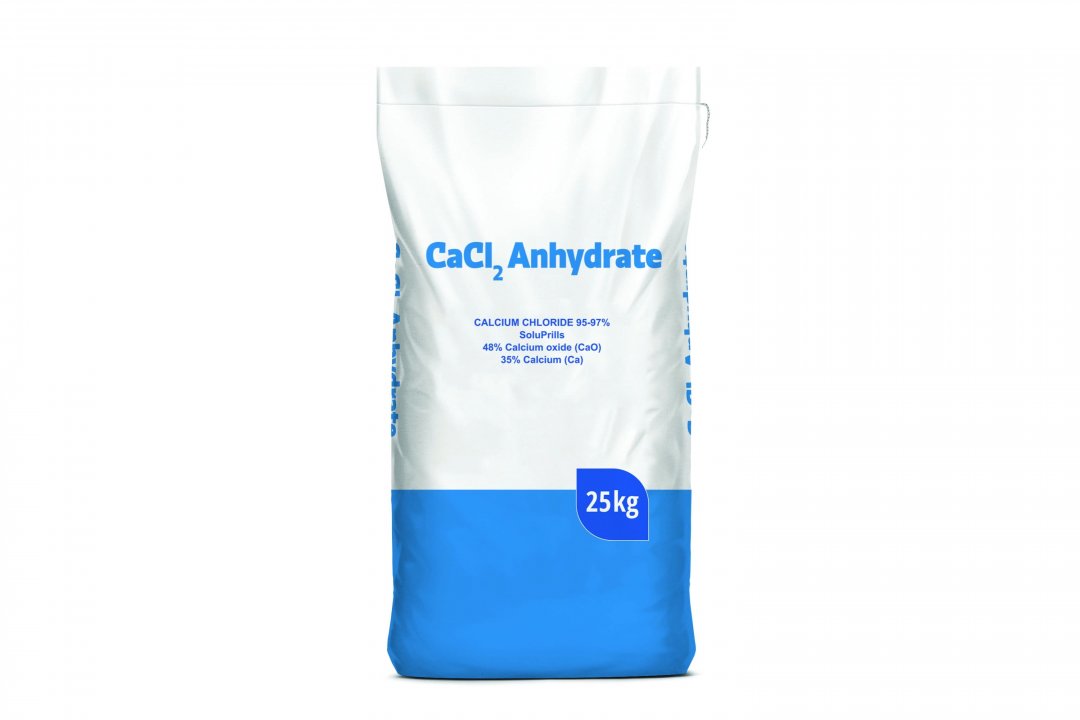
Alternative road salt – Calciumchloride anhydrous
- Environmentally safer
- Immediate action
- Easy-to-spread granules
- Non-caking or lump formation in the bag
- Purity: 95–97%
Calcium chloride 97% offers several advantages as an alternative to conventional road salt:
Faster and longer-lasting snow and ice melting
When calcium chloride anhydrous comes into contact with water, snow or freezing rain, it generates heat. As a result, the melting process starts almost immediately, allowing ice to detach more quickly from the road surface.
Excellent performance at very low temperatures
Calcium chloride anhydrous, when used as a de-icing agent, lowers the freezing point of water and remains effective down to -25 °C, whereas conventional sodium chloride loses its effectiveness at around -6 °C. This makes CaCl₂ anhydrous particularly suitable for severe winter conditions.
Lower product requirement per m²
Due to its high efficiency, a lower dosage of calcium chloride is required compared to traditional road salt. This leads to reduced consumption, lower operating costs and fewer spreading operations.
Reduced environmental impact compared to sodium chloride
Calcium chloride adheres to the road surface, which reduces dispersion and limits the amount of de-icing material that reaches roadside verges.
Environmental impact of road salt on soil structure
When sodium ions from conventional road salt leach into the soil, they bind to the clay adsorption complex. This displaces essential plant nutrients such as calcium (Ca²⁺) and magnesium (Mg²⁺). At the same time, sodium disrupts soil structure: clay particles swell, break apart and clog soil pores. As a result, water and air infiltration is reduced, placing plant roots under stress.
Environmental impact of road salt on vegetation
Over recent decades, extensive use of road salt has caused severe salinisation of roadside soils. As a consequence, natural vegetation can no longer thrive, and only halophytes (salt-tolerant plant species) are able to grow invasively along road infrastructure.
25 kg bag - 1200 kg bigbag
Best price/quality
Open communication
All NPK and PG mixes possible
Tailor made
REACH registered